Can Double-Wall Carbon Nanotubes Improve Conductivity in Lightweight Polymer Composites?
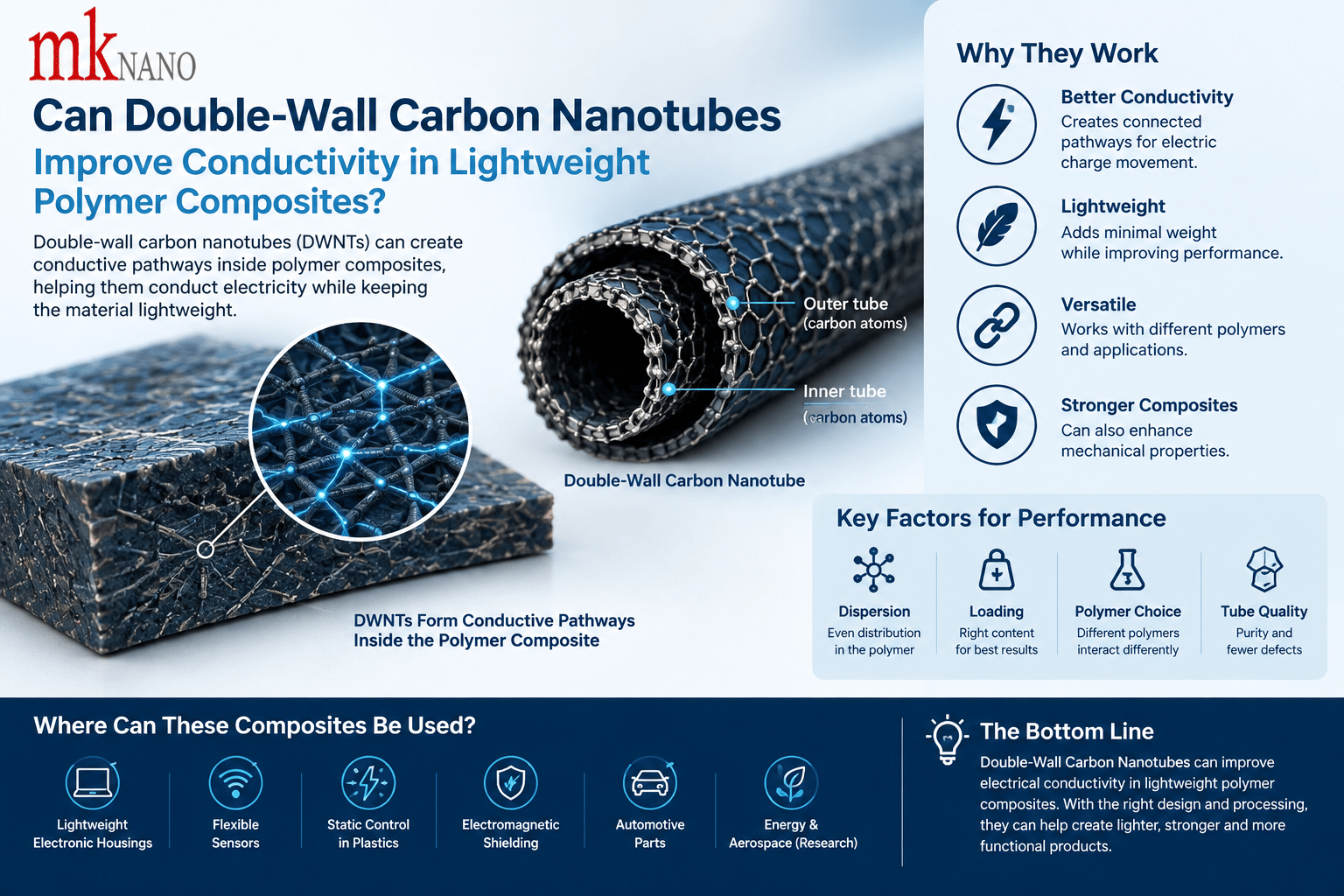
Lightweight materials play a key role in modern technology. Many industries need materials that are lightweight and conduct electricity well. Polymer composites offer a useful solution. They combine plastics with other materials to improve their properties. Double-wall carbon nanotubes can make these composites more conductive without adding much weight.
What Are Double-Wall Carbon Nanotubes?
Double-Wall Carbon Nanotubes are tiny tubes made from two layers of carbon. Each layer forms a rolled sheet of carbon atoms. These tubes have a very small size and a high length-to-width ratio.
Their structure gives them useful electrical and mechanical properties. They can carry electric current through suitable pathways. They can also help strengthen some polymer materials.
These features make them useful for advanced composite materials. Researchers study them for electronics, sensors, and other applications.
How Do They Improve Electrical Conductivity?
Most pure polymers do not conduct electricity well. Their structure does not allow electric charges to move freely. Adding conductive fillers can help solve this problem.
Double-walled carbon nanotubes can form connected pathways inside a polymer. These pathways allow electric charges to move through the material. This process can improve electrical conductivity.
The results depend on several factors. The amount of nanotubes matters. Their spread throughout the polymer also plays an important role. Good contact between nanotubes helps create effective conductive networks.
What Factors Affect Their Performance?
Several factors determine how well these nanotubes work.
• Dispersion: Even distribution helps create conductive pathways throughout the polymer.
• Loading: The right nanotube content can improve conductivity while limiting extra weight.
• Polymer choice: Different polymers interact with nanotubes in different ways.
• Tube quality: Purity, and structural defects can affect performance.
Where Can These Composites Be Used?
Conductive polymer composites can serve many practical purposes. They may support lightweight electronic housings and flexible sensors. They can also help control static electricity in plastic components.
Other possible uses include electromagnetic shielding and selected automotive parts. Researchers continue to study these materials for energy and aerospace applications. Each use requires testing to confirm safety and performance.
Conclusion
Double-Wall Carbon Nanotubes can improve electrical conductivity in lightweight polymer composites. They can create conductive pathways while adding little weight. Their performance depends on dispersion, loading, processing, and polymer compatibility.
With careful material design, these nanotubes can help create lighter and more functional products. Continued research will help manufacturers identify the most effective uses.